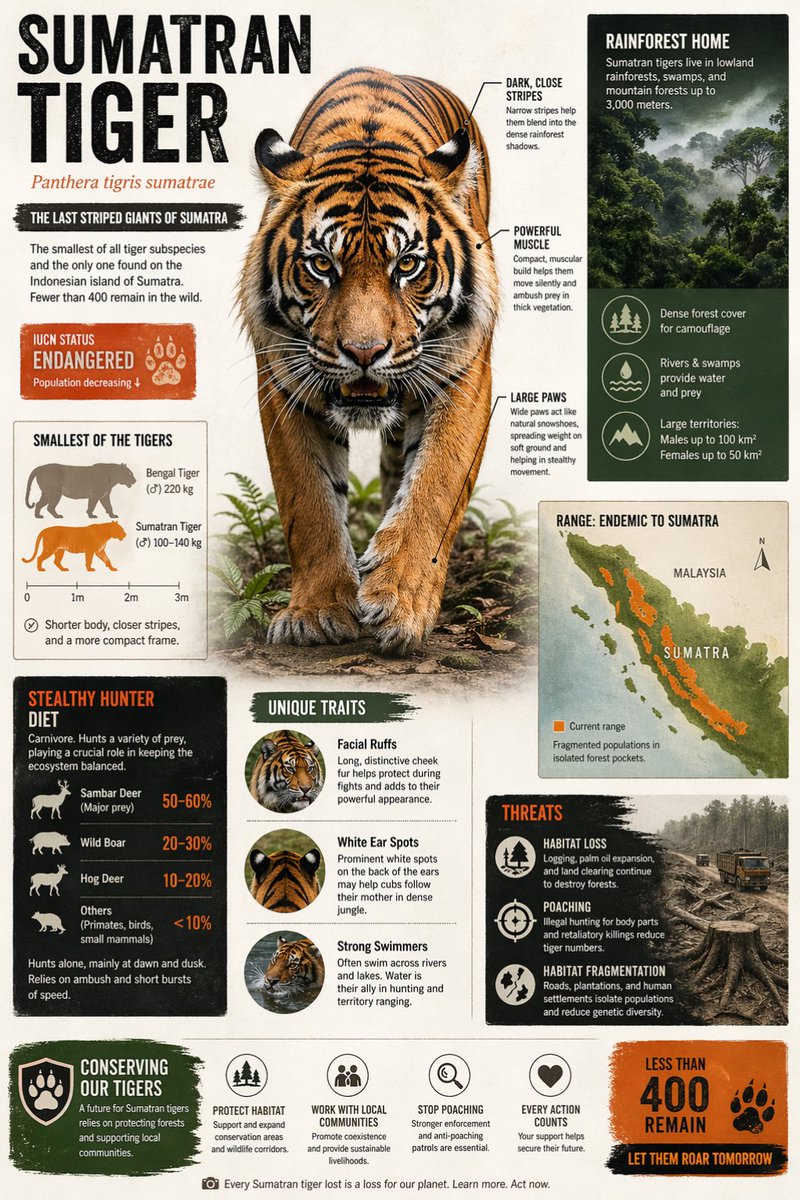
苏门答腊虎保护信息图
一份详尽的野生动物保护信息图海报,以中央的苏门答腊虎为核心,包含栖息地、分布范围、饮食、特征、威胁和保护措施等板块,适用于教育或宣传用途。
{
  "type": "wildlife conservation infographic poster",
  "subject": {
    "animal": "{argument name=\"animal name\" default=\"Sumatran Tiger\"}",
    "scientific_name": "{argument name=\"scientific name\" default=\"Panthera tigris sumatrae\"}",
    "pose": "front-facing full-body tiger walking directly toward the viewer, one forepaw stepping forward, intense eye contact, realistic anatomy, detailed fur and whiskers",
    "style": "high-detail natural history illustration mixed with editorial infographic design",
    "background": "off-white paper texture with subtle grain, clean poster layout"
  },
  "composition": {
    "centerpiece": "large central tiger occupying most of the vertical space, grounded on a small patch of soil and low jungle plants",
    "callouts": {
      "count": 3,
      "labels": [
        "DARK, CLOSE STRIPES",
        "POWERFUL MUSCLE",
        "LARGE PAWS"
      ],
      "style": "thin annotation lines pointing to stripe pattern, shoulder-body mass, and front paws"
    }
  },
  "layout": {
    "sections": [
      {
        "title": "{argument name=\"main title\" default=\"SUMATRAN TIGER\"}",
        "position": "top left",
        "count": 3,
        "labels": [
          "Panthera tigris sumatrae",
          "THE LAST STRIPED GIANTS OF SUMATRA",
          "The smallest of all tiger subspecies and the only one found on the Indonesian island of Sumatra. Fewer than 400 remain in the wild."
        ]
      },
      {
        "title": "IUCN STATUS",
        "position": "left upper-middle",
        "count": 2,
        "labels": [
          "ENDANGERED",
          "Population decreasing"
        ]
      },
      {
        "title": "SMALLEST OF THE TIGERS",
        "position": "left middle",
        "count": 2,
        "labels": [
          "Bengal Tiger (♂) 220 kg",
          "Sumatran Tiger (♂) 100–140 kg"
        ],
        "visual": "size comparison panel with two tiger silhouettes and a horizontal 0m to 3m scale"
      },
      {
        "title": "STEALTHY HUNTER DIET",
        "position": "bottom left",
        "count": 4,
        "labels": [
          "Sambar Deer 50–60%",
          "Wild Boar 20–30%",
          "Hog Deer 10–20%",
          "Others <10%"
        ],
        "notes": "includes short paragraph about solitary hunting at dawn and dusk using ambush and short bursts of speed"
      },
      {
        "title": "RAINFOREST HOME",
        "position": "top right",
        "count": 4,
        "labels": [
          "Dense forest cover for camouflage",
          "Rivers & swamps provide water and prey",
          "Large territories: Males up to 100 km² Females up to 50 km²",
          "Sumatran tigers live in lowland rainforests, swamps, and mountain forests up to 3,000 meters."
        ],
        "visual": "misty rainforest photo-style panel with three circular habitat icons"
      },
      {
        "title": "RANGE: ENDEMIC TO SUMATRA",
        "position": "right middle",
        "count": 3,
        "labels": [
          "MALAYSIA",
          "SUMATRA",
          "Current range"
        ],
        "visual": "map of western Indonesia with Sumatra highlighted in orange and fragmented tiger population zones marked"
      },
      {
        "title": "UNIQUE TRAITS",
        "position": "lower center",
        "count": 3,
        "labels": [
          "Facial Ruffs",
          "White Ear Spots",
          "Strong Swimmers"
        ],
        "visual": "three circular close-up images with short explanatory text for each trait"
      },
      {
        "title": "THREATS",
        "position": "lower right",
        "count": 3,
        "labels": [
          "HABITAT LOSS",
          "POACHING",
          "HABITAT FRAGMENTATION"
        ],
        "visual": "dark panel with white icons and a deforested landscape photo showing tree stumps and heavy machinery"
      },
      {
        "title": "CONSERVING OUR TIGERS",
        "position": "bottom left strip",
        "count": 5,
        "labels": [
          "A future for Sumatran tigers relies on protecting forest and supporting local communities.",
          "PROTECT HABITAT",
          "WORK WITH LOCAL COMMUNITIES",
          "STOP POACHING",
          "EVERY ACTION COUNTS"
        ]
      },
      {
        "title": "LESS THAN 400 REMAIN",
        "position": "bottom right corner",
        "count": 2,
        "labels": [
          "LESS THAN 400 REMAIN",
          "LET THEM ROAR TOMORROW"
        ]
      },
      {
        "title": "footer",
        "position": "bottom center",
        "count": 1,
        "labels": [
          "Every Sumatran tiger lost is a loss for our planet. Learn more. Act now."
        ]
      }
    ]
  },
  "design": {
    "palette": [
      "black",
      "warm orange",
      "forest green",
      "cream",
      "white",
      "muted gray"
    ],
    "typography": "bold condensed uppercase display font for headers, smaller clean sans-serif for body text, occasional distressed paint-stroke header backplates",
    "icons": "flat white conservation and habitat icons inside circular badges",
    "mood": "urgent, educational, conservation-focused, premium editorial poster"
  },
  "rendering": {
    "aspect_ratio": "2:3 vertical",
    "quality": "print-ready, crisp text, highly legible, polished magazine infographic aesthetic"
  }
}
{
"type": "野生动物保护信息图海报",
"subject": {
"animal": "{argument name=\"animal name\" default=\"苏门答腊虎\"}",
"scientific_name": "{argument name=\"scientific name\" default=\"Panthera tigris sumatrae\"}",
"pose": "正面全身老虎正朝观众走来,一只前爪迈出,眼神犀利,解剖结构写实,毛发和胡须细节丰富",
"style": "高细节自然历史插画与编辑信息图设计相结合",
"background": "带有细微纹理的米白色纸张质感,海报布局整洁"
},
"composition": {
"centerpiece": "占据大部分垂直空间的大型中央老虎,立于一小块泥土和低矮丛林植物之上",
"callouts": {
"count": 3,
"labels": [
"深色且紧密的条纹",
"强健的肌肉",
"巨大的爪子"
],
"style": "细标注线指向条纹图案、肩部肌肉群和前爪"
}
},
"layout": {
"sections": [
{
"title": "{argument name=\"main title\" default=\"苏门答腊虎\"}",
"position": "左上",
"count": 3,
"labels": [
"Panthera tigris sumatrae",
"苏门答腊最后的条纹巨人",
"所有虎亚种中体型最小的一种,也是唯一仅分布于印度尼西亚苏门答腊岛的虎。野外仅存不到 400 只。"
]
},
{
"title": "IUCN 现状",
"position": "左上中",
"count": 2,
"labels": [
"极危",
"种群数量正在减少"
]
},
{
"title": "体型最小的虎",
"position": "左中",
"count": 2,
"labels": [
"孟加拉虎 (♂) 220 kg",
"苏门答腊虎 (♂) 100–140 kg"
],
"visual": "带有两只老虎剪影和 0m 至 3m 水平比例尺的体型对比面板"
},
{
"title": "隐秘的猎手:饮食",
"position": "左下",
"count": 4,
"labels": [
"水鹿 50–60%",
"野猪 20–30%",
"猪鹿 10–20%",
"其他 <10%"
],
"notes": "包含一段关于它们如何在黎明和黄昏通过伏击及短距离冲刺进行独居狩猎的简短说明"
},
{
"title": "雨林家园",
"position": "右上",
"count": 4,
"labels": [
"茂密的森林覆盖利于伪装",
"河流与沼泽提供水源和猎物",
"领地广阔:雄性可达 100 km²,雌性可达 50 km²",
"苏门答腊虎栖息于低地雨林、沼泽和海拔 3,000 米以下的各种山地森林中。"
],
"visual": "带有三个圆形栖息地图标的雾气缭绕雨林照片风格面板"
},
{
"title": "分布范围:苏门答腊特有",
"position": "右中",
"count": 3,
"labels": [
"马来西亚",
"苏门答腊",
"当前分布范围"
],
"visual": "印度尼西亚西部地图,苏门答腊岛以橙色高亮显示,并标注了破碎化的老虎种群区域"
},
{
"title": "独特特征",
"position": "下中",
"count": 3,
"labels": [
"面部鬃毛",
"白色耳斑",
"游泳健将"
],
"visual": "三个圆形特写图像,配有针对每个特征的简短解释性文字"
},
{
"title": "威胁",
"position": "右下",
"count": 3,
"labels": [
"栖息地丧失",
"偷猎",
"栖息地破碎化"
],
"visual": "带有白色图标的深色面板,以及展示树桩和重型机械的森林砍伐景观照片"
},
{
"title": "保护我们的老虎",
"position": "左下条带",
"count": 5,
"labels": [
"苏门答腊虎的未来取决于保护森林和支持当地社区。",
"保护栖息地",
"与当地社区合作",
"制止偷猎",
"每一个行动都至关重要"
]
},
{
"title": "仅存不到 400 只",
"position": "右下角",
"count": 2,
"labels": [
"仅存不到 400 只",
"让它们的咆哮声延续到明天"
]
},
{
"title": "页脚",
"position": "下中",
"count": 1,
"labels": [
"失去每一只苏门答腊虎都是地球的损失。了解更多,立即行动。"
]
}
]
},
"design": {
"palette": [
"黑色",
"暖橙色",
"森林绿",
"奶油色",
"白色",
"柔和灰"
],
"typography": "标题使用粗体压缩大写展示字体,正文使用简洁的无衬线字体,偶尔使用做旧笔触风格的标题底板",
"icons": "圆形徽章内的扁平白色保护和栖息地图标",
"mood": "紧迫、教育性、以保护为核心、高端编辑海报风格"
},
"rendering": {
"aspect_ratio": "2:3 垂直",
"quality": "适合打印,文字清晰,易读性高,精致的杂志信息图美学"
}
}