<instruction>
Analyze the entire composition of the input image. Identify all key subjects present (whether a single person, group/couple, vehicle, or specific object) and their spatial relationships/interactions.
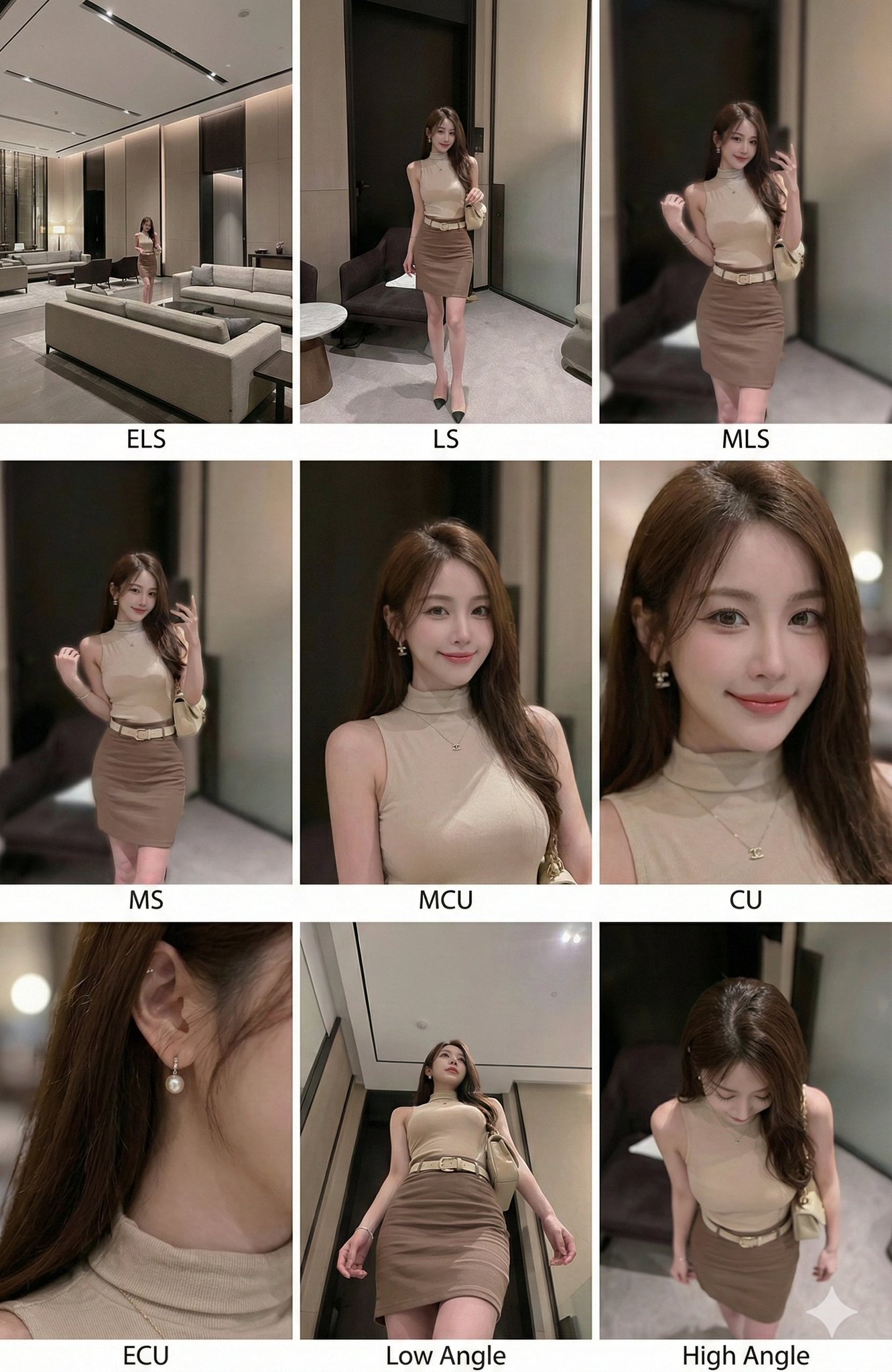
Generate a coherent 3x3 grid "Contact Sheet" showcasing 9 distinct shots of exactly these subjects within the same environment.
You must adapt standard cinematic shot types to fit the content (e.g., if a group, keep the group together; if an object, frame the entire object):
Row 1 (Establishing Context):
1. Extreme Long Shot (ELS): Subjects appear very small within a vast environment.
2. Long Shot (LS): Full subject or group visible from top to bottom (head to toe / wheels to roof).
3. Medium Long Shot (American Shot/Three-Quarter): Framed from above the knees (for people) or a 3/4 view (for objects).
Row 2 (Core Coverage):
4. Medium Shot (MS): Framed from above the waist (or the central core of an object). Focus on interaction/action.
5. Medium Close-Up (MCU): Framed from above the chest. Intimate framing of the primary subject(s).
6. Close-Up (CU): Tight framing on the face or the "front" of an object.
Row 3 (Detail & Angles):
7. Extreme Close-Up (ECU): Macro detail with intense focus on a key feature (eyes, hands, logo, texture).
8. Low-Angle Shot (Worm's-Eye View): Looking up at the subject from ground level (spectacular/heroic feel).
9. High-Angle Shot (Bird's-Eye View): Looking down on the subject from above.
Ensure strict consistency: The same people/objects, same clothing, and same lighting across all 9 panels. Depth of field should vary realistically (background blur in close-ups).
</instruction>
A professional 3x3 cinematic storyboard grid containing 9 panels.
This grid showcases the specific subject(s)/scene from the input image across a comprehensive range of focal lengths.
Top Row: Wide environmental shots, full view, 3/4 crop (above-knee view).
Middle Row: Above-waist view, above-chest view, face/front close-up.
Bottom Row: Macro detail, low angle, high angle.
All frames feature photorealistic textures, consistent cinematic color grading, and correct framing for the specific number of subjects or objects analyzed.
<instruction> (指令)
分析输入图像的整个构图。识别所有存在的关键主体(无论是单人、群体/情侣、车辆还是特定物体)及其空间关系/互动。
生成一个连贯的 3x3 网格“电影印样(Contact Sheet)”,展示在同一环境中完全是这些主体的 9 个不同镜头。
你必须调整标准的电影镜头类型以适应内容(例如,如果是群体,保持群体在一起;如果是物体,构图包含整个物体):
第 1 行(建立背景):
大远景 (ELS): 主体在广阔的环境中显得很小。
全景 (LS): 完整的主体或群体从上到下可见(从头到脚 / 从车轮到车顶)。
中远景 (美式镜头/四分之三): 构图从膝盖以上(针对人物)或 3/4 视角(针对物体)。
第 2 行(核心覆盖):
4. 中景 (MS): 构图从腰部以上(或物体的中心核心)。聚焦于互动/动作。
5. 中特写 (MCU): 构图从胸部以上。主要主体的亲密构图。
6. 特写 (CU): 紧凑构图于脸部或物体的“正面”。
第 3 行(细节与角度):
7. 大特写 (ECU): 强烈聚焦于关键特征(眼睛、手、标志、纹理)的微距细节。
8. 低角度镜头 (仰视/虫眼): 从地面仰望主体(壮观/英雄感)。
9. 高角度镜头 (俯视/鸟瞰): 从上方俯瞰主体。
确保严格的一致性:所有 9 个面板中是相同的人物/物体、相同的衣服和相同的光照。景深应逼真地变化(特写镜头中的背景虚化)。
</instruction>
一个包含 9 个面板的专业 3x3 电影故事板网格。
该网格以全面的焦距范围展示输入图像中的特定主体/场景。
顶行: 宽广环境镜头,全视图,3/4 剪辑(膝上景)。
中间行: 腰部以上视图,胸部以上视图,脸部/正面特写。
底行: 微距细节,低角度,高角度。
所有帧均具有照片般逼真的纹理,一致的电影级调色,以及针对所分析的主体或物体特定数量的正确构图。
<instruction>
입력 이미지의 전체 구성을 분석하세요. 모든 주요 피사체(단일 인물, 그룹/커플, 차량 또는 특정 객체)를 식별하고 그들의 공간적 관계/상호작용을 파악하세요.
동일한 환경 내에서 정확히 이 피사체들을 보여주는 9개의 독특한 샷으로 구성된 일관된 3x3 그리드 "콘택트 시트"를 생성하세요.
표준 영화 촬영 유형을 콘텐츠에 맞게 조정해야 합니다 (예: 그룹일 경우, 그룹을 함께 유지; 객체일 경우, 전체 객체를 프레임에 담기):
1행 (맥락 설정):
1. 익스트림 롱 샷 (ELS): 피사체가 넓은 환경 내에서 매우 작게 나타남.
2. 롱 샷 (LS): 피사체 또는 그룹이 위에서 아래까지 (머리부터 발끝/바퀴부터 지붕까지) 완전히 보임.
3. 미디엄 롱 샷 (아메리칸 샷/쓰리쿼터): 무릎 위에서 프레임 (사람의 경우) 또는 3/4 뷰 (객체의 경우).
2행 (핵심 커버리지):
4. 미디엄 샷 (MS): 허리 위에서 프레임 (또는 객체의 중심부). 상호작용/행동에 초점.
5. 미디엄 클로즈업 (MCU): 가슴 위에서 프레임. 주요 피사체의 친밀한 프레이밍.
6. 클로즈업 (CU): 얼굴 또는 객체의 "앞면"에 대한 타이트한 프레이밍.
3행 (디테일 및 각도):
7. 익스트림 클로즈업 (ECU): 주요 특징 (눈, 손, 로고, 질감)에 집중한 매크로 디테일.
8. 로우 앵글 샷 (벌레의 시점): 지면에서 피사체를 올려다보는 시점 (장엄/영웅적 느낌).
9. 하이 앵글 샷 (새의 시점): 위에서 피사체를 내려다보는 시점.
엄격한 일관성을 보장하세요: 동일한 사람/객체, 동일한 의상, 동일한 조명이 9개의 모든 패널에 걸쳐 유지됩니다. 심도는 현실적으로 다양해야 합니다 (클로즈업에서 배경 흐림).
</instruction>
전문적인 3x3 시네마틱 스토리보드 그리드, 9개의 패널로 구성.
이 그리드는 입력 이미지의 특정 피사체/장면을 다양한 초점 거리로 포괄적으로 보여줍니다.
상단 행: 넓은 환경 샷, 전체 보기, 3/4 크롭 (무릎 위 보기).
중간 행: 허리 위 보기, 가슴 위 보기, 얼굴/앞면 클로즈업.
하단 행: 매크로 디테일, 로우 앵글, 하이 앵글.
모든 프레임은 포토리얼리스틱한 질감, 일관된 시네마틱 색상 그레이딩, 분석된 특정 피사체 또는 객체 수에 맞는 올바른 프레이밍을 특징으로 합니다.