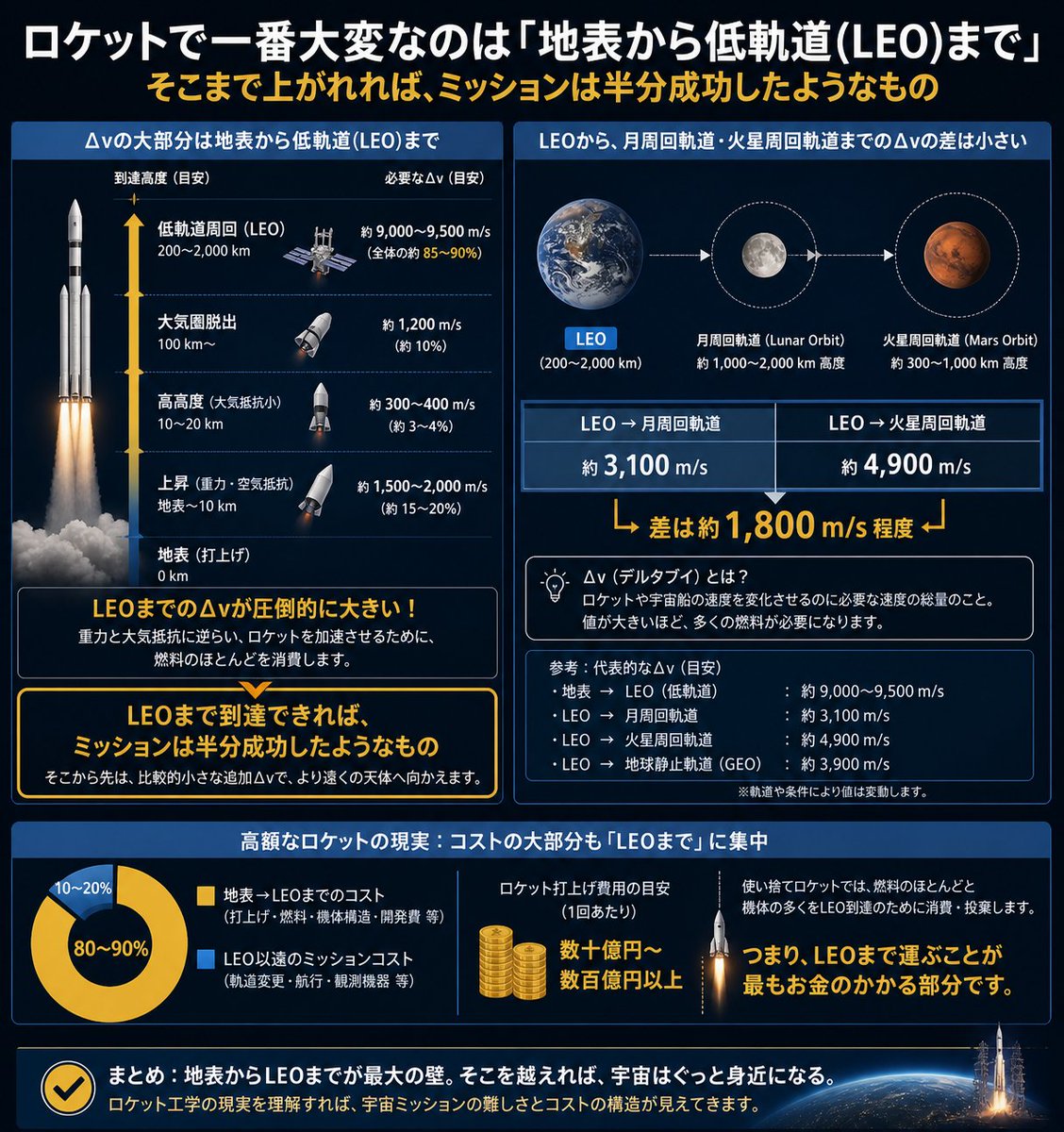
LEO 火箭 Delta-V 信息图
生成一张日语工程信息图,解释为什么抵达近地轨道是火箭任务中最困难且成本最高的部分。
{
  "type": "Japanese rocket engineering infographic",
  "format": "single square educational infographic, 1:1 aspect ratio",
  "theme": "explain that the hardest part of a rocket mission is getting from Earth's surface to low Earth orbit, based on basic rocket engineering",
  "language": "Japanese",
  "visual style": "dark navy space-tech infographic with bright blue section headers, yellow-orange highlights, white Japanese typography, clean engineering diagrams, realistic 3D rocket and planet renders, high contrast, polished social media explainer design",
  "headline": "{argument name=\"headline text\" default=\"ロケットで一番大変なのは「地表から低軌道(LEO)まで」\"}",
  "subtitle": "{argument name=\"subtitle text\" default=\"そこまで上がれれば、ミッションは半分成功したようなもの\"}",
  "canvas": {
    "background": "deep navy gradient with subtle grid lines and space atmosphere glow",
    "border": "thin blue outline around the full infographic",
    "layout": "top headline, two large upper panels side by side, a wide middle cost panel, and a bottom summary banner"
  },
  "layout": {
    "sections count": 5,
    "sections": [
      {
        "title": "Δvの大部分は地表から低軌道(LEO)まで",
        "position": "upper left",
        "content type": "vertical altitude and delta-v comparison chart with rocket launch illustration",
        "main visual": "large white-and-black heavy rocket lifting off at far left with bright orange flames and smoke cloud",
        "chart columns": ["到達高度(目安)", "必要なΔv(目安)"],
        "altitude stages count": 4,
        "altitude stages": [
          {"label": "低軌道周回(LEO)", "altitude": "200〜2,000 km", "delta v": "約9,000〜9,500 m/s(全体の約85〜90%)", "icon": "small satellite"},
          {"label": "大気圏脱出", "altitude": "100 km〜", "delta v": "約1,200 m/s(約10%)", "icon": "small angled rocket"},
          {"label": "高高度(大気抵抗小)", "altitude": "10〜20 km", "delta v": "約300〜400 m/s(約3〜4%)", "icon": "small rocket"},
          {"label": "上昇(重力・空気抵抗)", "altitude": "地表〜10 km", "delta v": "約1,500〜2,000 m/s(約15〜20%)", "icon": "small rocket nose-up"}
        ],
        "callouts count": 2,
        "callouts": [
          {"text": "LEOまでのΔvが圧倒的に大きい!", "style": "yellow headline inside bordered dark box"},
          {"text": "LEOまで到達できれば、ミッションは半分成功したようなもの", "style": "larger orange bordered box with downward arrow"}
        ]
      },
      {
        "title": "LEOから、月周回軌道・火星周回軌道までのΔvの差は小さい",
        "position": "upper right",
        "content type": "space trajectory comparison diagram and delta-v table",
        "celestial bodies count": 3,
        "celestial bodies": [
          {"label": "LEO", "description": "Earth with blue atmosphere, dotted circular orbit, label 200〜2,000 km"},
          {"label": "月周回軌道(Lunar Orbit)", "description": "gray Moon in dotted orbit, label 約1,000〜2,000 km 高度"},
          {"label": "火星周回軌道(Mars Orbit)", "description": "orange Mars in dotted orbit, label 約300〜1,000 km 高度"}
        ],
        "trajectory arrows count": 2,
        "trajectory arrows": ["Earth/LEO to Moon", "Moon to Mars"],
        "comparison boxes count": 2,
        "comparison boxes": [
          {"label": "LEO → 月周回軌道", "value": "約3,100 m/s"},
          {"label": "LEO → 火星周回軌道", "value": "約4,900 m/s"}
        ],
        "highlight": "差は約1,800 m/s程度",
        "definition box": {
          "title": "Δv(デルタブイ)とは?",
          "text": "ロケットや宇宙船の速度を変化させるのに必要な速度の総量のこと。値が大きいほど、多くの燃料が必要になります。",
          "icon": "light bulb"
        },
        "reference list count": 4,
        "reference list": [
          "地表 → LEO(低軌道): 約9,000〜9,500 m/s",
          "LEO → 月周回軌道: 約3,100 m/s",
          "LEO → 火星周回軌道: 約4,900 m/s",
          "LEO → 地球静止軌道(GEO): 約3,900 m/s"
        ],
        "footnote": "※燃費や条件により値は変動します。"
      },
      {
        "title": "高額なロケットの現実:コストの大部分も「LEOまで」に集中",
        "position": "middle full width",
        "content type": "cost breakdown panel",
        "subcomponents count": 4,
        "subcomponents": [
          {"type": "donut chart", "label": "80〜90%", "secondary label": "10〜20%", "colors": "yellow and blue"},
          {"type": "legend", "items count": 2, "items": ["地表→LEOまでのコスト(打上げ・燃料・機体構造・開発費 等)", "LEO以遠のミッションコスト(軌道変更・航行・観測機器 等)"]},
          {"type": "coin stack illustration", "label": "ロケット打上げ費用の目安(1回あたり)", "value": "数十億円〜数百億円以上"},
          {"type": "small rocket launch icon and explanatory text", "text": "使い捨てロケットでは、燃料のほとんど、機体の多くをLEO到達のために消費・投棄します。つまり、LEOまで運ぶことが最もお金のかかる部分です。"}
        ]
      },
      {
        "title": "まとめ:地表からLEOまでが最大の壁。そこを越えれば、宇宙はぐっと身近になる。",
        "position": "bottom full width",
        "content type": "summary banner",
        "icon": "large yellow checkmark in circle at left",
        "background visual": "curved Earth horizon and small rocket launch at right",
        "body text": "ロケット工学の現実を理解すれば、宇宙ミッションの難しさとコストの構造が見えてきます。"
      },
      {
        "title": "overall visual accents",
        "position": "throughout",
        "content type": "decorative technical elements",
        "items count": 5,
        "items": ["blue panel headers", "orange arrows", "thin divider lines", "small spacecraft icons", "glowing yellow emphasis text"]
      }
    ]
  },
  "typography": {
    "headline": "large bold white Japanese sans-serif with quoted LEO phrase",
    "subtitle": "bold yellow Japanese sans-serif",
    "body": "compact clean white Japanese text",
    "numbers": "large bold white and yellow numerals for delta-v values"
  },
  "color palette": {
    "primary background": "{argument name=\"background color\" default=\"deep navy blue\"}",
    "accent": "{argument name=\"accent color\" default=\"golden yellow-orange\"}",
    "secondary": "electric blue",
    "text": "white"
  },
  "rendering instructions": "Create a crisp, readable, information-dense Japanese infographic suitable for X/Twitter. Keep all labels sharp and legible, align panels cleanly, preserve the exact Japanese text where specified, use realistic rocket/planet illustrations mixed with flat UI-style charts, and avoid clutter outside the structured panels."
}
{
"type": "日语火箭工程信息图",
"format": "单张正方形教育信息图,1:1 长宽比",
"theme": "基于基础火箭工程学,解释火箭任务中最困难的部分是从地表抵达近地轨道",
"language": "日语",
"visual style": "深海军蓝太空科技风信息图,配以亮蓝色章节标题、黄橙色高亮、白色日语字体、简洁的工程图解、逼真的 3D 火箭与行星渲染,高对比度,精致的社交媒体科普设计",
"headline": "{argument name=\"headline text\" default=\"火箭发射最难的一步:从地表到近地轨道(LEO)\"}",
"subtitle": "{argument name=\"subtitle text\" default=\"只要能抵达那里,任务就相当于成功了一半\"}",
"canvas": {
"background": "深海军蓝渐变,带有细微的网格线和太空氛围光晕",
"border": "整张信息图周围有细蓝色边框",
"layout": "顶部标题,上方两个大面板并排,中间一个宽成本面板,底部一个总结横幅"
},
"layout": {
"sections count": 5,
"sections": [
{
"title": "大部分 Δv 消耗在从地表到近地轨道(LEO)的过程中",
"position": "左上",
"content type": "垂直高度与 delta-v 对比图表,配火箭发射插图",
"main visual": "最左侧为大型黑白重型火箭升空,带有明亮的橙色火焰和烟云",
"chart columns": ["到达高度(参考)", "所需 Δv(参考)"],
"altitude stages count": 4,
"altitude stages": [
{"label": "近地轨道(LEO)", "altitude": "200〜2,000 km", "delta v": "约 9,000〜9,500 m/s(总量的约 85〜90%)", "icon": "小型卫星"},
{"label": "脱离大气层", "altitude": "100 km 以上", "delta v": "约 1,200 m/s(约 10%)", "icon": "小型倾斜火箭"},
{"label": "高空(大气阻力小)", "altitude": "10〜20 km", "delta v": "约 300〜400 m/s(约 3〜4%)", "icon": "小型火箭"},
{"label": "上升(重力与空气阻力)", "altitude": "地表〜10 km", "delta v": "约 1,500〜2,000 m/s(约 15〜20%)", "icon": "小型火箭机头向上"}
],
"callouts count": 2,
"callouts": [
{"text": "抵达 LEO 所需的 Δv 极其巨大!", "style": "深色边框内的黄色标题"},
{"text": "只要能抵达 LEO,任务就相当于成功了一半", "style": "带有向下箭头的橙色大边框"}
]
},
{
"title": "从 LEO 到月球轨道或火星轨道的 Δv 差值较小",
"position": "右上",
"content type": "太空轨道对比图与 delta-v 表格",
"celestial bodies count": 3,
"celestial bodies": [
{"label": "LEO", "description": "带有蓝色大气的地球,虚线圆形轨道,标注 200〜2,000 km"},
{"label": "月球轨道(Lunar Orbit)", "description": "虚线轨道上的灰色月球,标注约 1,000〜2,000 km 高度"},
{"label": "火星轨道(Mars Orbit)", "description": "虚线轨道上的橙色火星,标注约 300〜1,000 km 高度"}
],
"trajectory arrows count": 2,
"trajectory arrows": ["地球/LEO 到月球", "月球到火星"],
"comparison boxes count": 2,
"comparison boxes": [
{"label": "LEO → 月球轨道", "value": "约 3,100 m/s"},
{"label": "LEO → 火星轨道", "value": "约 4,900 m/s"}
],
"highlight": "差值仅约 1,800 m/s",
"definition box": {
"title": "什么是 Δv(Delta-v)?",
"text": "指改变火箭或航天器速度所需的总速度量。数值越大,所需的燃料就越多。",
"icon": "灯泡"
},
"reference list count": 4,
"reference list": [
"地表 → LEO(近地轨道): 约 9,000〜9,500 m/s",
"LEO → 月球轨道: 约 3,100 m/s",
"LEO → 火星轨道: 约 4,900 m/s",
"LEO → 地球静止轨道(GEO): 约 3,900 m/s"
],
"footnote": "※数值会因燃油效率和条件而异。"
},
{
"title": "昂贵火箭的现实:大部分成本也集中在“抵达 LEO”",
"position": "中间全宽",
"content type": "成本构成面板",
"subcomponents count": 4,
"subcomponents": [
{"type": "环形图", "label": "80〜90%", "secondary label": "10〜20%", "colors": "黄色和蓝色"},
{"type": "图例", "items count": 2, "items": ["地表→LEO 成本(发射、燃料、机体结构、研发费等)", "LEO 以外的任务成本(轨道变更、航行、观测仪器等)"]},
{"type": "硬币堆叠插图", "label": "火箭发射费用参考(单次)", "value": "数十亿至数百亿日元以上"},
{"type": "小型火箭发射图标与说明文字", "text": "在一次性火箭中,大部分燃料和机体结构都在抵达 LEO 的过程中被消耗或丢弃。换句话说,运送到 LEO 是最昂贵的部分。"}
]
},
{
"title": "总结:从地表到 LEO 是最大的壁垒。跨越它,宇宙将变得触手可及。",
"position": "底部全宽",
"content type": "总结横幅",
"icon": "左侧圆圈内的大型黄色勾选标记",
"background visual": "弯曲的地平线和右侧的小型火箭发射",
"body text": "理解火箭工程的现实,就能看清太空任务的难度与成本结构。"
},
{
"title": "整体视觉装饰",
"position": "贯穿全图",
"content type": "装饰性技术元素",
"items count": 5,
"items": ["蓝色面板标题", "橙色箭头", "细分割线", "小型航天器图标", "发光的黄色强调文字"]
}
]
},
"typography": {
"headline": "大型加粗白色日语无衬线字体,包含 LEO 短语",
"subtitle": "加粗黄色日语无衬线字体",
"body": "紧凑简洁的白色日语文本",
"numbers": "用于 delta-v 数值的大号加粗白色和黄色数字"
},
"color palette": {
"primary background": "{argument name=\"background color\" default=\"深海军蓝\"}",
"accent": "{argument name=\"accent color\" default=\"金黄橙色\"}",
"secondary": "电光蓝",
"text": "白色"
},
"rendering instructions": "制作一张清晰、信息密度高、适合 X/Twitter 的日语信息图。保持所有标签锐利易读,面板对齐整洁,保留指定的日语文本,将逼真的火箭/行星插图与扁平化 UI 风格图表相结合,并避免结构化面板之外的杂乱内容。"
}