Invention Timeline
此提示词可生成一张羊皮纸风格的教育海报,展示一个标注了发明立体模型的网格,非常适合用于时间轴信息图表和改变世界的科技对比。
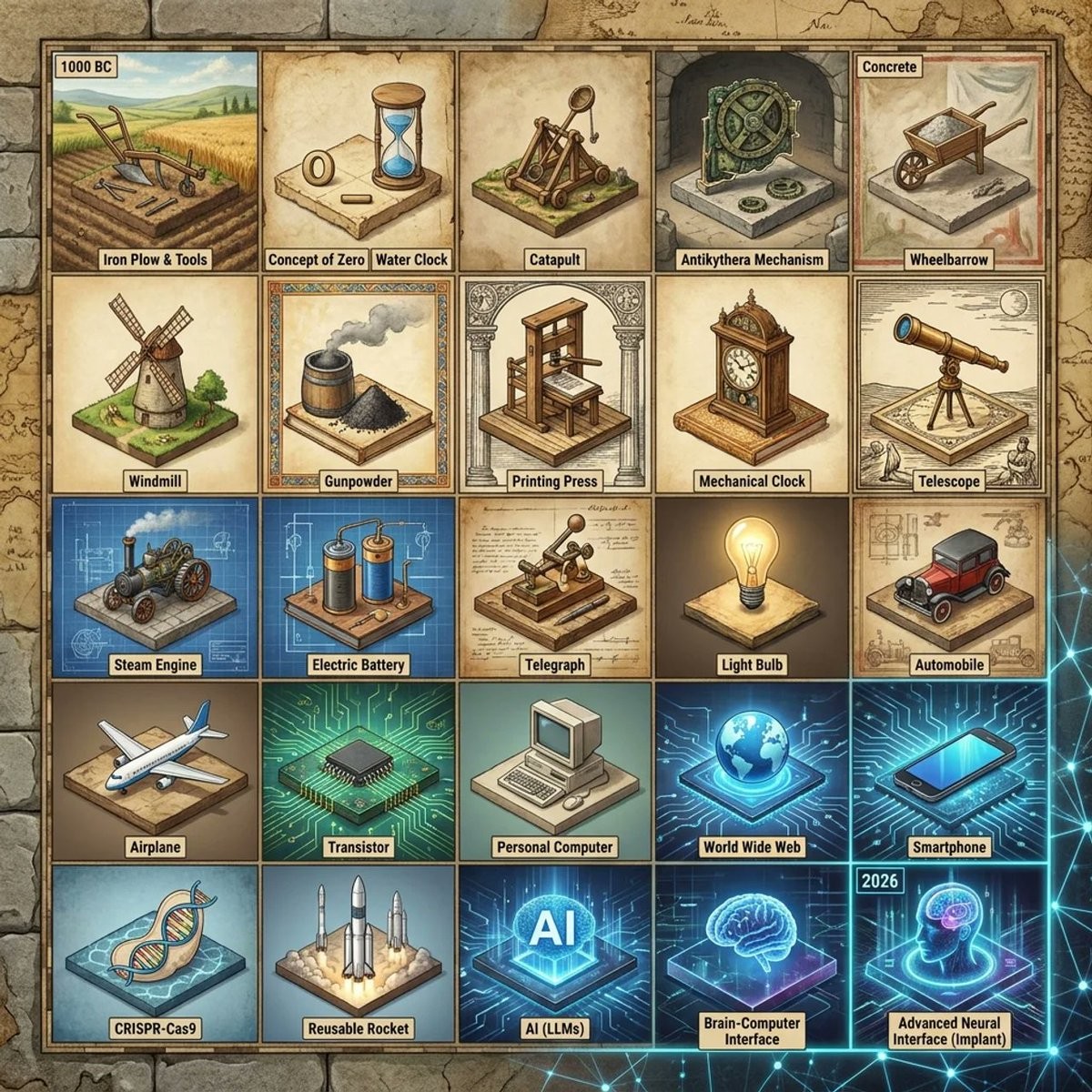
Create a square infographic-style illustration showing a {argument name="grid size" default="15×15"} invention timeline grid rendered as a collection of miniature isometric dioramas on aged parchment tiles. The image should look like a curated historical poster that spans from {argument name="starting year" default="1000 BC"} to {argument name="ending year" default="2026"}, with one invention per tile and no repeats. Show the visible portion as a 5 by 5 section of the larger grid, for a total of 25 labeled tiles, arranged in neat rows and columns with thin dark borders. Every tile contains a unique world-changing invention depicted as a small handcrafted diorama with era-appropriate materials, colors, and background details. Use a warm antiquarian palette for ancient and medieval inventions, sepia technical-document tones for early modern inventions, and cooler neon-blue futuristic lighting for modern digital and biotech inventions. Surround the grid with an old-map border and subtle historical cartography textures, blending into faint modern network graphics near the bottom right.

Label each visible tile with a small beige caption tag in bold black text. Include exactly these 25 visible inventions in reading order from top left to bottom right: 1) {argument name="first tile label" default="1000 BC"} tile showing an iron plow and simple hand tools in a farm field, captioned "Iron Plow & Tools"; 2) "Concept of Zero" shown as a parchment-like tile with a carved zero symbol and a blue hourglass; 3) "Water Clock" shown as a wooden water-timing device; 4) "Catapult" shown as a wooden siege engine; 5) "Antikythera Mechanism" shown as an intricate bronze gear device in a stone niche; 6) "Concrete" shown as a wheelbarrow filled with wet cement or mortar; 7) "Wheelbarrow" shown as a simple wooden one-wheel cart; 8) "Windmill" shown as a traditional mill on grassy ground; 9) "Gunpowder" shown as a barrel and a mound of black powder with smoke; 10) "Printing Press" shown as a wooden press framed by classical columns; 11) "Mechanical Clock" shown as an ornate standing clock; 12) "Telescope" shown as an early brass telescope on a tripod with sketch-like scientific notes; 13) "Steam Engine" shown on a blue blueprint-style tile with an early locomotive engine; 14) "Electric Battery" shown on a blueprint-like tile with two cylindrical battery cells and wiring; 15) "Telegraph" shown as a Morse telegraph key on technical paper; 16) "Light Bulb" shown glowing warmly on a neutral pedestal; 17) "Automobile" shown as an early red motorcar on a workshop-plan background; 18) "Airplane" shown as a commercial jet aircraft in miniature; 19) "Transistor" shown as a black microchip on a luminous circuit-board tile; 20) "Personal Computer" shown as a beige desktop computer with CRT monitor and keyboard; 21) "World Wide Web" shown as a glowing blue globe over digital circuitry; 22) "Smartphone" shown as a sleek modern phone on a neon-tech background; 23) "CRISPR-Cas9" shown as a DNA double helix in a biotech-blue display tile; 24) "Reusable Rocket" shown as several upright rockets launching with exhaust clouds; 25) "AI (LLMs)" shown as glowing large letters AI in a holographic tech cube; 26) "Brain-Computer Interface" shown as a glowing brain hologram on a blue platform; 27) "Advanced Neural Interface (Implant)" shown as a transparent human head profile with a glowing brain implant, with a small top label reading "2026".

Keep the composition highly organized, poster-like, and visually dense, with each tile readable at a glance. Use slight isometric perspective, crisp linework, painterly shading, and polished editorial illustration quality. The overall feeling should combine museum poster, educational timeline, and imaginative historical-tech diorama art.
创建一个方形信息图风格的插图,展示一个 {argument name="grid size" default="15×15"} 的发明时间轴网格,渲染为陈旧羊皮纸砖块上的微型等轴测立体模型集合。图像应看起来像一张精心策划的历史海报,跨度从 {argument name="starting year" default="公元前 1000 年"} 到 {argument name="ending year" default="2026 年"},每个砖块展示一项发明,且不重复。显示较大网格中 5 乘 5 的可见部分,总共 25 个带有标签的砖块,排列整齐,行与列之间有细深色边框。每个砖块都包含一项改变世界的独特发明,描绘成带有时代特征的材料、颜色和背景细节的小型手工立体模型。古代和中世纪发明使用温暖的古董色调,早期现代发明使用棕褐色技术文档色调,现代数字和生物技术发明使用冷色调的霓虹蓝灯光。网格周围环绕着旧地图边框和微妙的历史制图纹理,右下角逐渐融入淡淡的现代网络图形。
用醒目的黑色粗体文字为每个可见砖块贴上米色小标签。按从左上到右下的阅读顺序,包含以下 25 项可见发明:1) {argument name="first tile label" default="公元前 1000 年"} 砖块,展示农田里的铁犁和简易手工工具,标签为“铁犁与工具”;2) “零的概念”,展示为带有雕刻零符号和蓝色沙漏的羊皮纸风格砖块;3) “水钟”,展示为木制计时装置;4) “投石机”,展示为木制攻城器械;5) “安提基特拉机械”,展示为石龛中复杂的青铜齿轮装置;6) “混凝土”,展示为装满湿水泥或砂浆的手推车;7) “独轮车”,展示为简单的木制单轮车;8) “风车”,展示为草地上的传统磨坊;9) “火药”,展示为木桶和一堆带有烟雾的黑色粉末;10) “印刷机”,展示为古典圆柱框架下的木制印刷机;11) “机械钟”,展示为华丽的立式钟;12) “望远镜”,展示为三脚架上的早期黄铜望远镜,配有素描风格的科学笔记;13) “蒸汽机”,展示在蓝色蓝图风格的砖块上,带有早期火车头引擎;14) “电池”,展示在蓝图风格的砖块上,带有两个圆柱形电池单元和线路;15) “电报”,展示为技术纸张上的莫尔斯电报键;16) “灯泡”,展示在中性底座上发出温暖的光;17) “汽车”,展示为车间规划背景下的早期红色汽车;18) “飞机”,展示为微型商用喷气式飞机;19) “晶体管”,展示为发光项目砖块上的黑色微芯片;20) “个人电脑”,展示为带有 CRT 显示器和键盘的米色台式电脑;21) “万维网”,展示为数字电路之上发光的蓝色地球仪;22) “智能手机”,展示为霓虹科技背景下时尚的现代手机;23) “CRISPR-Cas9”,展示为生物科技蓝色显示砖块中的 DNA 双螺旋结构;24) “可重复使用火箭”,展示为几枚竖立发射并带有尾气的火箭;25) “AI (LLMs)”,展示为全息科技立方体中发光的巨大字母 AI;26) “脑机接口”,展示为蓝色平台上的发光大脑全息图;27) “高级神经接口 (植入物)”,展示为带有发光大脑植入物的透明人头侧影,顶部带有小标签“2026 年”。
保持构图高度组织化、海报感强且视觉密集,每个砖块一目了然。使用轻微的等轴测透视、清晰的线条、绘画般的阴影和精致的编辑插图质量。整体感觉应结合博物馆海报、教育时间轴和富有想象力的历史科技立体模型艺术。오래된 양피지 타일에 그려진 미니어처 등각 투영의 디오라마 컬렉션으로, {argument name="grid size" default="15×15"}의 발명 타임라인 그리드를 보여주는 정사각형 인포그래픽 스타일의 일러스트를 만듭니다. 이미지는 {argument name="starting year" default="기원전 1000년"}부터 {argument name="ending year" default="2026년"}까지의 역사적 포스터처럼 보여야 하며, 각 타일에는 하나의 발명이 표시되고 중복은 없습니다. 큰 그리드의 5×5 가시 부분을 표시하고 총 25개의 레이블이 있는 타일을 정돈된 행과 열로 배치하며 얇은 어두운 경계선으로 둘러싸입니다. 각 타일에는 시대에 적합한 재료, 색상 및 배경 세부 정보로 묘사된 세계를 변화시키는 독특한 발명이 포함되어 있습니다. 고대 및 중세 발명에는 따뜻한 고풍 색조를 사용하고, 초기 현대 발명에는 세피아 기술 문서 톤을 사용하며, 현대 디지털 및 생명공학 발명에는 차가운 네온 블루 미래 조명을 사용합니다. 그리드 주변에는 오래된 지도 경계선과 미세한 역사적 지도 텍스처가 있으며, 오른쪽 하단에는 희미한 현대 네트워크 그래픽이 녹아듭니다.
각 가시 타일에는 굵은 검은 텍스트로 작은 베이지색 캡션 태그를 붙입니다. 왼쪽 상단에서 오른쪽 하단으로 읽는 순서에 따라 다음 25개의 가시 발명을 포함합니다: 1) {argument name="first tile label" default="기원전 1000년"} 타일에는 농장 밭에 있는 철제 쟁기와 간단한 수공구가 표시되며, 캡션은 "철제 쟁기와 도구"입니다. 2) "제로의 개념"은 조각된 제로 기호와 파란 모래시계가 있는 양피지 스타일의 타일로 표시됩니다. 3) "물시계"는 나무로 된 물 타이밍 장치로 표시됩니다. 4) "투석기"는 나무로 된 공성 무기로 표시됩니다. 5) "안티키테라 기계"는 돌 틈에 있는 복잡한 청동 기어 장치로 표시됩니다. 6) "콘크리트"는 젖은 시멘트 또는 모르타르로 가득 찬 손수레로 표시됩니다. 7) "손수레"는 간단한 나무로 된 한 바퀴 수레로 표시됩니다. 8) "풍차"는 풀밭에 있는 전통적인 밀로 표시됩니다. 9) "화약"은 연기를 동반한 검은 가루 더미와 통으로 표시됩니다. 10) "인쇄기"는 고전적인 기둥으로 둘러싸인 나무 프레스로 표시됩니다. 11) "기계식 시계"는 화려한 스탠딩 시계로 표시됩니다. 12) "망원경"은 삼각대 위에 있는 초기 황동 망원경으로, 스케치 스타일의 과학적 노트가 첨부되어 있습니다. 13) "증기 기관"은 초기 기관차 엔진이 있는 파란색 설계도 스타일의 타일로 표시됩니다. 14) "전지"는 두 개의 원통형 배터리 셀과 배선이 있는 설계도 스타일의 타일로 표시됩니다. 15) "전신"은 기술 종이 위에 있는 모스 전신 키로 표시됩니다. 16) "전구"는 중립적인 받침대 위에서 따뜻하게 빛납니다. 17) "자동차"는 작업장 계획 배경에 있는 초기 빨간 자동차로 표시됩니다. 18) "비행기"는 미니어처 상업용 제트기로 표시됩니다. 19) "트랜지스터"는 발광 회로 기판 타일 위에 있는 검은 마이크로칩으로 표시됩니다. 20) "개인용 컴퓨터"는 CRT 모니터와 키보드가 있는 베이지색 데스크탑 컴퓨터로 표시됩니다. 21) "월드 와이드 웹"은 디지털 회로 위에 발광하는 파란색 지구본으로 표시됩니다. 22) "스마트폰"은 네온 기술 배경에 있는 세련된 현대 전화로 표시됩니다. 23) "CRISPR-Cas9"는 생명공학 파란색 디스플레이 타일에 있는 DNA 이중 나선으로 표시됩니다. 24) "재사용 가능한 로켓"은 배기 구름과 함께 발사되는 여러 개의 세운 로켓으로 표시됩니다. 25) "AI (LLMs)"는 발광하는 큰 글자 AI가 있는 홀로그램 기술 큐브로 표시됩니다. 26) "뇌-컴퓨터 인터페이스"는 파란색 플랫폼 위에 있는 발광하는 뇌 홀로그램으로 표시됩니다. 27) "고급 신경 인터페이스(임플란트)"는 발광하는 뇌 임플란트를 가진 투명한 인간 머리 측면으로 표시되며, 작은 상단 레이블에는 "2026년"이라고 적혀 있습니다.
구성은 매우 조직적이고 포스터 같은 느낌을 주며 시각적으로 밀도가 높고 각 타일은 한눈에 읽을 수 있도록 합니다. 약간의 등각 투시, 선명한 선 작업, 화가 같은 음영 및 세련된 편집 일러스트 품질을 사용합니다. 전체적인 느낌은 박물관 포스터, 교육 타임라인 및 상상력이 풍부한 역사 기술 디오라마 아트를 결합한 것입니다.