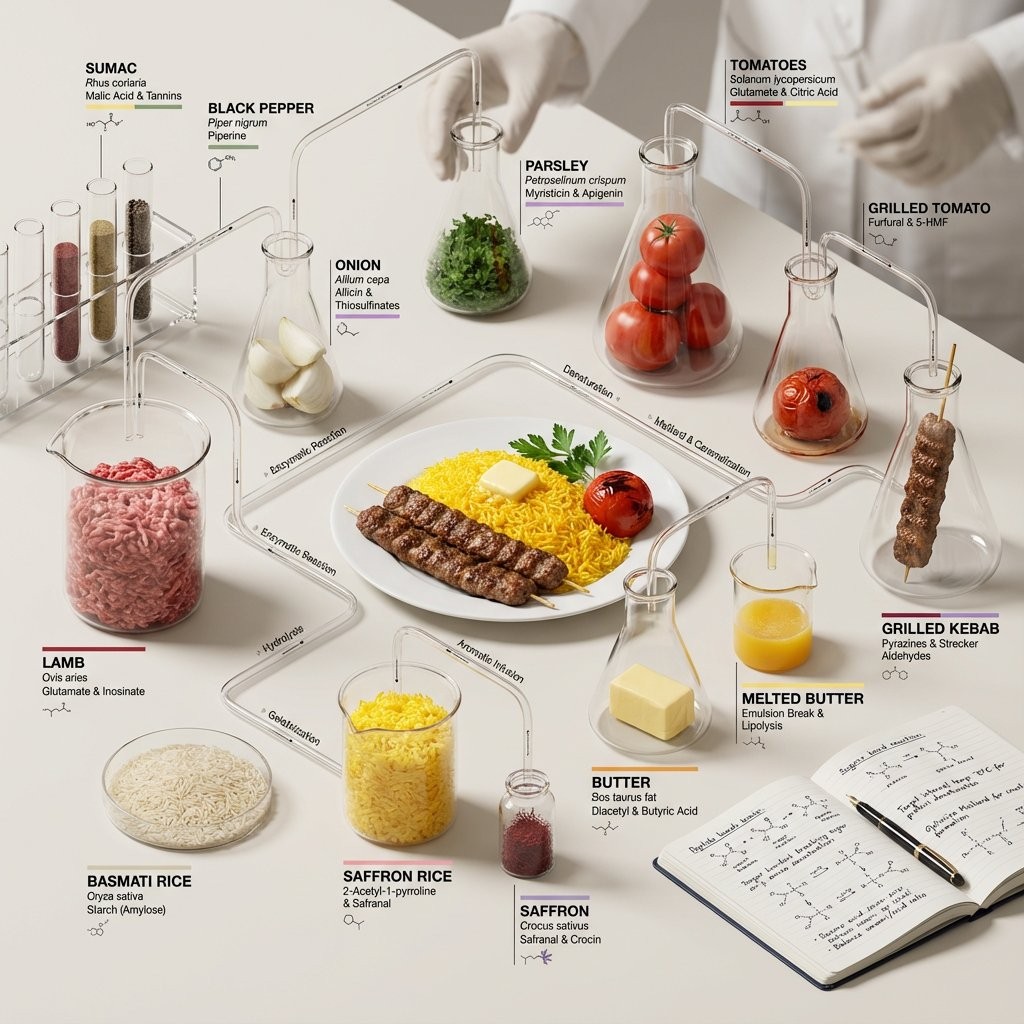
<instruction> chelo kebab
 Input A: photo or dish name .

Input A: Analyze the dish's full ingredient list, key flavor compounds, and major chemical processes (Maillard, caramelization, emulsification, denaturation) involved in cooking it.

Optional Input B: style reference (sterile pharmaceutical lab / Muji minimalism). If missing, choose "sleek modern chemistry lab meets high end coffee-table still life."

Goal: Create an isometric 3D diorama of a lab bench converted into a tasting station for the dish. Each ingredient is in its own piece of lab glassware, labeled with culinary + chemical information, connected by thin glass tubing showing reaction pathways.

Rules:

Neutral background, matte light gray or off-white, very soft shadows.

Central elevated platform holds a perfect, plated version of the final dish on a white porcelain plate.

Around it, arrange 10–16 pieces of glassware (Erlenmeyer flasks, beakers, petri dishes, volumetric flasks, test tubes in racks).

Each glass item contains:

Realistic ingredient specimen (raw or prepared)

Small label strip with:

Ingredient common name in bold

Scientific/Latin name in smaller text

Primary flavor molecule name + tiny skeletal formula icon

Fine glass tubing connects certain vessels, with small arrow icons and micro text like "Maillard," "Emulsion," "Hydrolysis" indicating key reactions.

Use subtle color coding in the label stickers (no big boxes):

Umami (deep red line)

Sweet (soft pink line)

Sour (pale yellow line)

Bitter (sage green line)

Fat (warm orange line)

Aromatic (lavender line)

Include one open lab notebook on the bench with a hand-drawn reaction scheme and cooking notes in fountain-pen ink.

Typography: clean sans-serif like Helvetica Neue, thin weights, lots of white space on labels.

Glassware is ultra-clear with realistic specular highlights, liquid menisci, and slight distortions.

No visible human figures, just gloved hands blurred in the deep background (optional).

Output: ONE image, 4:5 aspect ratio, high-end product / editorial photography style, isometric or ¾ angle, soft studio lighting, hyper realistic materials.
</instruction>
<instruction>
切洛烤肉串
输入A:照片或菜名。

输入A:分析该菜肴的完整配料清单、关键风味化合物以及烹饪过程中涉及的主要化学反应(美拉德反应、焦糖化、乳化、变性)。

可选输入B:风格参考(无菌制药实验室/无印极简)。如缺失,则选择"时尚现代化学实验室遇上高端咖啡桌静物"。

目标:创建一个等距3D立体模型,将实验台改造成该菜肴的品鉴台。每种配料放在各自的实验室玻璃器皿中,贴有烹饪+化学信息标签,通过细玻璃管显示反应路径。

规则:

中性背景,哑光浅灰或灰白色,极柔和的阴影。

中央抬升平台摆放一份完美摆盘的最终菜肴,置于白色瓷盘上。

周围布置10–16件玻璃器皿(锥形瓶、烧杯、培养皿、容量瓶、试管架)。

每件玻璃容器内含:

逼真的配料标本(生的或已处理)

小标签条:

配料常用名加粗

科学/拉丁名小号字体

主要风味分子名称+微小骨架式图标

细玻璃管连接特定容器,带小箭头图标和微文字如"美拉德""乳化""水解"指示关键反应。

标签贴使用微妙的色彩编码(无大色块):

鲜味(深红线)

甜味(柔粉红线)

酸味(淡黄线)

苦味(鼠尾草绿线)

脂肪(暖橙线)

芳香(薰衣草紫线)

实验台上放一本摊开的实验笔记本,手绘反应示意图和烹饪笔记,用钢笔墨水书写。

字体:干净无衬线如Helvetica Neue,细字重,标签留白充足。

玻璃器皿超清透,真实镜面高光、液体弯月面、轻微畸变。

无可见人形,仅深背景可选虚化戴手套的手。

输出:单张图片,4:5宽高比,高端产品/编辑摄影风格,等距或¾视角,柔和工作室布光,超写实材质。
</instruction>
<instruction>
치로 바베큐 스키워
입력 A: 사진 또는 요리 이름.

입력 A: 이 요리의 전체 재료 목록, 주요 풍미 화합물 및 조리 과정에서 관련된 주요 화학 반응(마일라드 반응, 캐러멜화, 유화, 변성)을 분석합니다.

선택적 입력 B: 스타일 참조(무균 제약 실험실/무인 극소형). 누락된 경우 "패셔너블한 현대 화학 실험실과 고급 커피 테이블 정물의 만남"을 선택합니다.

목표: 실험대를 이 요리의 시식대로 변형한 등거리 3D 입체 모델을 생성합니다. 각 재료는 각자의 실험실 유리 용기에 담겨 있으며, 조리 + 화학 정보 라벨이 붙어 있고, 세밀한 유리관을 통해 반응 경로를 표시합니다.

규칙:

중성 배경, 매트한 연회색 또는 회백색, 매우 부드러운 그림자.

중앙 상승 플랫폼에 완벽하게 플레이팅된 최종 요리가 흰색 도자기 접시에 놓입니다.

주변에 10–16개의 유리 용기(플라스크, 비커, 배양 접시, 용적병, 시험관대)가 배치됩니다.

각 유리 용기에는:

사실적인 재료 표본(생것 또는 처리된 것)

작은 라벨 조각:

재료의 일반 이름은 굵게

과학/라틴 이름은 소형 글꼴

주요 풍미 분자 이름 + 미세한 골격 아이콘

세밀한 유리관이 특정 용기에 연결되어 있으며, 작은 화살표 아이콘과 "마일라드", "유화", "가수분해"와 같은 미세한 텍스트로 주요 반응을 나타냅니다.

라벨은 미세한 색상 코딩(큰 색 블록 없음)을 사용합니다:

감칠맛(진한 빨간 선)

단맛(부드러운 분홍 선)

신맛(연한 노란 선)

쓴맛(세이지 그린 선)

지방(따뜻한 오렌지 선)

향기(라벤더 퍼플 선)

실험대 위에는 펼쳐진 실험 노트북이 놓여 있으며, 손으로 그린 반응 도식과 요리 노트가 만년필 잉크로 작성되어 있습니다.

글꼴: 깨끗한 산세리프체, Helvetica Neue와 같은, 얇은 글자 두께, 라벨에 충분한 여백.

유리 용기는 초고화질로, 실제 거울 같은 하이라이트, 액체의 곡면, 약간의 왜곡이 있습니다.

보이는 인체는 없으며, 깊은 배경에 장갑을 낀 손이 흐릿하게 선택적으로 나타납니다.

출력: 단일 이미지, 4:5 비율, 고급 제품/편집 사진 스타일, 등거리 또는 ¾ 시점, 부드러운 스튜디오 조명, 초현실적인 재질.
</instruction>