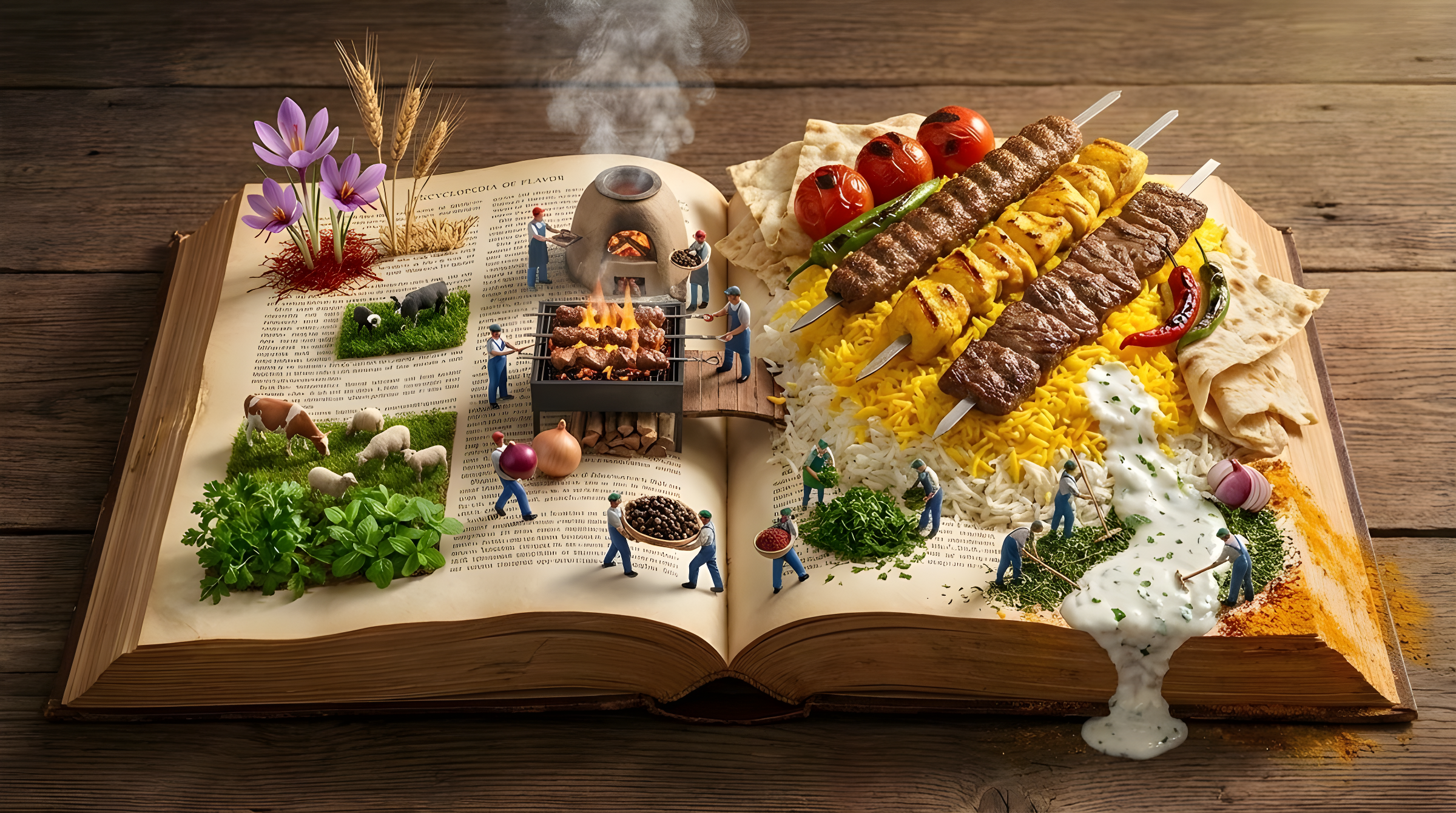
Input Variable: [INSERT CUISINE OR DISH] (e.g., Persian Kebabs, Japanese Sushi, Italian Pasta, Mexican Tacos)

System Instruction:
Generate a hyper-realistic, wide-angle (16:9) 3D diorama of an "Encyclopedia of Flavor." Use the following logic to procedurally generate the scene:

1. Flavor Profiling:
   Analyze the Input: Determine the Region, Staple Ingredients, and Cooking Method.
   (e.g., Kebab = Fire/Coal, Rice, Meat. Sushi = Water, Fish, Rice).
   The Terrain: The pages of the book must physically transform into the landscape of the cuisine.
   Grain: Rice or Couscous forms dunes.
   Liquid: Sauces or Broths form rivers.
   Solid: Bread or Meat forms mountains/cliffs.

2. Container (The Wide Atlas):
   The Object: A massive, horizontal Landscape-Format Atlas lying open on an aged wooden banquet table.
   The Spine: Runs horizontally through the center, acting as the "Equator" or "Main Road" of the scene.
   The Paper: Parchment texture. The edges of the pages are tattered and stained with spices (Saffron, Paprika, Turmeric).

3. Panoramic Composition (Left to Right Flow):
   CRITICAL: Do not place distinct plates. Create a continuous flow across the open spread.
   Left Side (The Origin - Agriculture): The raw ingredients grow out of the paper.
   (e.g., Wheat stalks rising from the text; Cattle grazing on parsley fields; Fishermen casting nets into ink-blue water).
   Center (The Process - The Kitchen): The spine is the cooking zone.
   (e.g., A miniature Tandoor oven or Grill built into the book binding; Steam rising volumetrically).
   Right Side (The Result - The Feast): The finished dish explodes in scale.
   (e.g., A mountain of Saffron Rice topped with the Kebab; A Ziggurat of Sushi).

4. The Micro-Population
   The Figures: 1:87 Scale (HO Scale) figures populate the landscape.
   The Action: They are working the food.
   Harvesting: Picking herbs from the margins.
   Transporting: Carrying giant peppercorns like boulders.
   Cooking: Using flamethrowers to char the meat or rakes to fluff the rice.

5. Lighting & Atmosphere:
   Aspect Ratio: 16:9 Horizontal.
   Lighting: "Golden Hour" side-lighting. It should skim across the texture of the food and the paper grain, emphasizing the "Landscape" feel.
   Steam: Volumetric steam connects the three zones (Left, Center, Right).

Output: ONE image, 16:9 Aspect Ratio, Macro Diorama Photography, Octane Render, High Texture Fidelity.
{
  "输入变量": "[요리 또는 요리명 삽입] (예: 페르시아 바비큐, 일본 스시, 이탈리아 파스타, 멕시코 타코)",

  "系统指令": {
    "生成一个超写实的宽幅(16:9)3D立体模型\"风味百科全书\"": "초현실적인 와이드(16:9) 3D 입체 모델 \"풍미 백과사전\"을 생성합니다. 다음 논리 프로그램을 사용하여 장면을 생성합니다:",

    "1. 风味分析": {
      "分析输入": "입력 분석: 지역, 주요 재료 및 조리 방법을 확인합니다.",
      "(如:烤肉 = 火/炭、米饭、肉类。寿司 = 水、鱼、米饭)": "(예: 바비큐 = 불/숯, 밥, 고기. 스시 = 물, 생선, 밥).",
      "地形": "지형: 책 페이지는 요리의 지형으로 물리적으로 변환되어야 합니다.",
      "谷物": "곡물: 밥이나 쿠스쿠스가 모래 언덕을 형성합니다.",
      "液体": "액체: 소스나 육수가 강을 형성합니다.",
      "固体": "고체: 빵이나 고기가 산맥/절벽을 형성합니다."
    },

    "2. 容器(宽幅地图集)": {
      "物体": "물체: 거대한 가로 풍경 형식의 지도집이 오래된 나무 연회 테이블 위에 펼쳐져 있습니다.",
      "书脊": "책등: 수평으로 중앙을 가로지르며 장면의 \"적도\" 또는 \"주간 도로\" 역할을 합니다.",
      "纸张": "종이: 양피지 질감. 페이지 가장자리는 손상되고 향신료(사프란, 고춧가루, 강황)로 염색되어 있습니다."
    },

    "3. 全景构图(从左到右的流动)": {
      "关键": "핵심: 독립 접시를 놓지 마십시오. 펼쳐진 책 페이지에서 연속적인 흐름을 만듭니다.",
      "左侧(起源 - 农业)": "왼쪽(기원 - 농업): 생 재료가 페이지에서 자라납니다.",
      "(如:麦穗从文字中升起;牛群在欧芹田间吃草;渔民在墨蓝色水中撒网)": "(예: 밀 이삭이 글자에서 솟아오르고; 소들이 파슬리 밭에서 풀을 뜯고; 어부가 짙은 파란색 물에서 그물을 던집니다).",
      "中央(过程 - 厨房)": "중앙(과정 - 주방): 책등이 요리 구역입니다.",
      "(如:内置在书脊中的微型坦都尔烤炉或烤架;体积感的蒸汽升起)": "(예: 책등에 내장된 미니 탄두르 오븐 또는 그릴; 입체감 있는 증기가 올라옵니다).",
      "右侧(结果 - 盛宴)": "오른쪽(결과 - 연회): 완성된 요리가 대폭발합니다.",
      "(如:藏红花米饭山顶着烤肉;寿司金字塔)": "(예: 사프란 밥 위에 바비큐가 있고; 스시 피라미드가 있습니다)."
    },

    "4. 微型人口": {
      "人物": "인물: 1:87 비율(HO 비율)의 인물이 지형에 분포합니다.",
      "动作": "동작: 그들은 음식을 가공하고 있습니다.",
      "采摘": "따기: 페이지 가장자리에서 허브를 따고 있습니다.",
      "运输": "운반: 거대한 후추 알갱이를 옮기듯 큰 돌을 옮깁니다.",
      "烹饪": "요리: 화염 방사기로 고기를 굽거나 갈퀴로 밥을 부풀립니다."
    },

    "5. 光线与氛围": {
      "宽高比": "가로 세로 비율: 16:9 가로.",
      "光线": "\"황금 시간\" 측면 조명. 음식 질감과 종이 질감을 스치며 \"지형\" 느낌을 강조해야 합니다.",
      "蒸汽": "입체감 있는 증기가 세 개의 영역(왼쪽, 중앙, 오른쪽)을 연결합니다."
    }
  },

  "输出": "단일 이미지, 16:9 가로 세로 비율, 근접 입체 모델 사진, Octane 렌더링, 높은 질감 충실도."
}