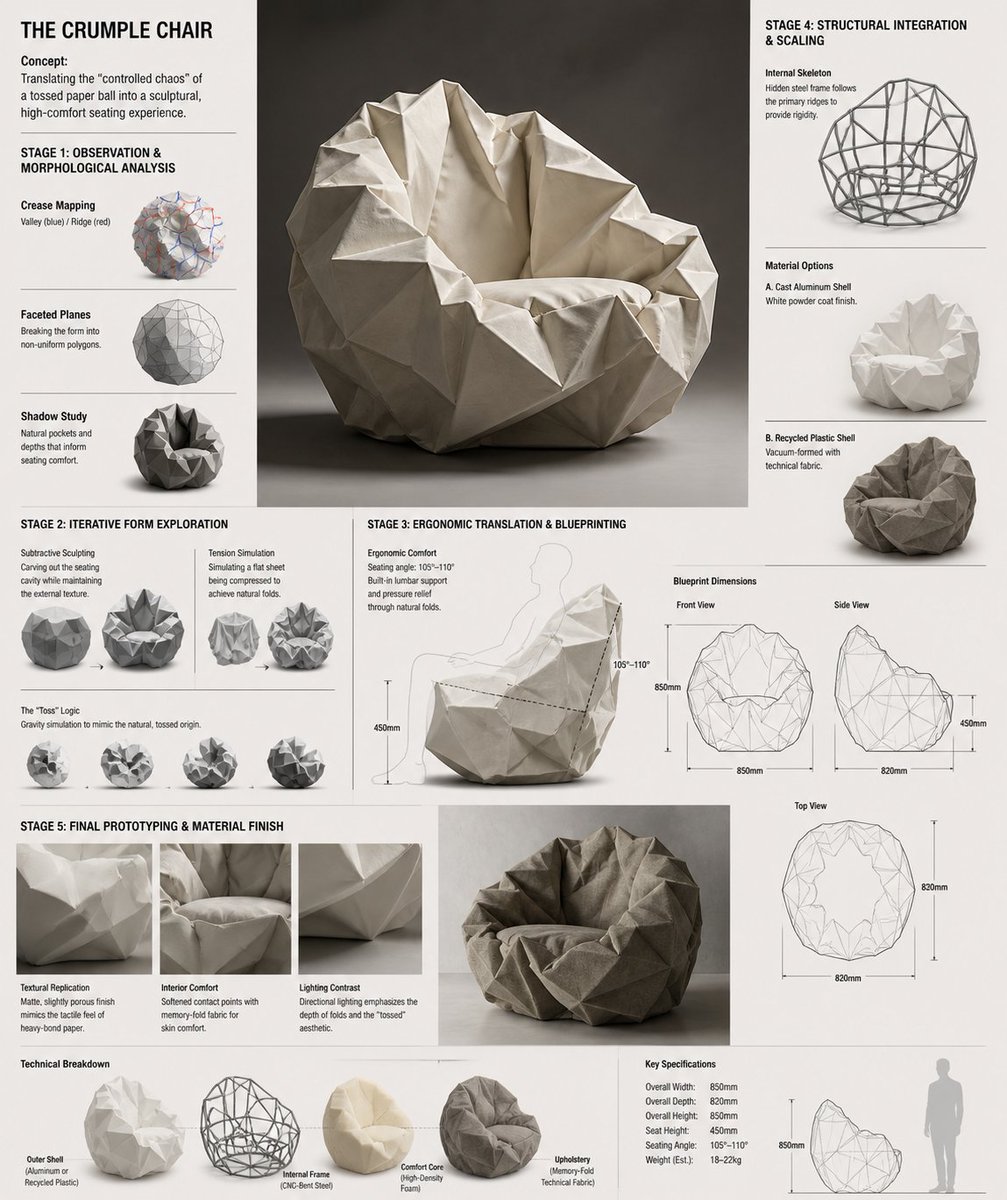
揉皱纸张家具概念设计
一份详尽的建筑与产品设计提示词,旨在将揉皱纸张的有机纹理转化为如椅子和沙发等高舒适度的雕塑感家具。
Design Concept: {argument name="furniture type" default="The Crumple Chair"} Core Philosophy: Translating the "controlled chaos" of a {argument name="inspiration" default="tossed paper ball"} into a sculptural, high-comfort seating experience.\n\nStage 1: Observation & Morphological Analysis The goal is to deconstruct the image of the crumpled paper into usable geometric data. Crease Mapping: Identify the primary "valley" and "ridge" lines. These represent potential structural ribs or seams in the chair. Faceted Planes: Break down the sphere into a series of non-uniform polygons. Each flat surface of the paper becomes a potential panel for the chair’s upholstery or shell. Shadow Study: Analyze how the "tossed" form creates deep recesses. These natural pockets guide where the user’s weight will be cradled. \n\nStage 2: Iterative Form Exploration Moving from a sphere to a seat through "Digital Crumpling." Subtractive Sculpting: Imagine the paper ball as a solid mass. Use Boolean operations to "carve out" a seating cavity that fits the human form while maintaining the external jagged texture. Tension Simulation: Use 3D software (like Rhino or Blender) to simulate a flat sheet of material being compressed. This ensures the folds look authentic and not "modeled." The "Toss" Logic: Experiment with gravity-based simulation dropping a digital mesh to see how it settles naturally, mimicking the "tossed" origin. \n\nStage 3: Ergonomic Translation & Blueprinting Refining the raw aesthetic into a functional object. The Comfort Core: Overlay a standard ergonomic template (Seating Angle: 105°–110°) over the crumpled form. Adjust the internal "folds" to provide lumbar support and pressure relief. Blueprint Generation: Create technical orthographic views (Front, Side, Top). Map out the dimensions: Seat Height: 450mm Total Width: 850mm Surface Smoothing: Maintain the sharp "paper edges" on the exterior shell while softening the interior contact points for skin comfort. \n\nStage 4: Structural Integration & Scaling Making the concept physically viable. The Skeleton: Design a hidden internal frame (likely CNC-bent steel rods or a 3D-printed lattice) that follows the most prominent ridges of the paper folds to provide rigidity. Material Selection: * Option A (High-End): {argument name="material" default="Faceted, cast aluminum"} with a white powder coat. Option B (Soft): Vacuum-formed recycled plastic shell covered in "memory-fold" technical fabric that retains a wrinkled appearance. \n\nStage 5: Final Prototyping & Material Finish Textural Replication: Apply a matte, slightly porous finish to the material to mimic the tactile feel of heavy-bond paper. Lighting Contrast: Use directional studio lighting in the final renders to emphasize the "tossed" shadows, making the chair look like a giant piece of discarded inspiration. Design Tip: To keep the "tossed" look authentic, avoid symmetry.设计概念:{argument name="furniture type" default="揉皱椅"} 核心理念:将 {argument name="inspiration" default="揉成团的纸球"} 的“受控混乱”转化为一种具有雕塑感且高度舒适的座椅体验。\n\n第一阶段:观察与形态分析 目标是将揉皱纸张的意象解构为可用的几何数据。折痕映射:识别主要的“谷线”和“脊线”。这些线条代表了椅子潜在的结构肋条或接缝。多面平面:将球体分解为一系列不规则的多边形。纸张的每一个平面都成为椅子软包或外壳的潜在面板。阴影研究:分析“揉皱”形态如何形成深邃的凹槽。这些天然的口袋引导着用户重量的承托位置。\n\n第二阶段:迭代形态探索 通过“数字揉皱”从球体过渡到座椅。减法雕刻:将纸球想象为一个实体。使用布尔运算“雕刻出”一个既符合人体工学又保持外部锯齿状纹理的座椅凹槽。张力模拟:使用 3D 软件(如 Rhino 或 Blender)模拟一张平面材料被压缩的过程。这能确保折痕看起来真实,而非“建模”出来的。 “抛掷”逻辑:尝试基于重力的模拟,将数字网格落下,观察其自然沉降的状态,以模仿“抛掷”的原始感。\n\n第三阶段:人体工学转换与蓝图绘制 将原始美学升华为功能性物体。舒适核心:在揉皱形态上覆盖标准的工学模板(座椅角度:105°–110°)。调整内部“折痕”以提供腰部支撑和压力缓解。蓝图生成:创建技术正投影视图(前视图、侧视图、顶视图)。规划尺寸:座高:450 mm,总宽:850 mm。表面平滑处理:在外壳上保持锐利的“纸张边缘”,同时软化内部接触点以确保皮肤触感舒适。\n\n第四阶段:结构集成与缩放 使概念具备物理可行性。骨架:设计一个隐藏的内部框架(建议使用 CNC 弯曲钢杆或 3D 打印晶格),使其沿着纸张折痕最明显的脊线分布,以提供刚性。材料选择:* 选项 A(高端):{argument name="material" default="多面铸铝"},配以白色粉末涂层。选项 B(柔软):真空成型的再生塑料外壳,覆盖“记忆折痕”科技面料,以保持褶皱外观。\n\n第五阶段:最终原型与材料饰面 纹理复制:在材料上应用哑光、微孔饰面,以模仿厚重纸张的触感。光影对比:在最终渲染中使用定向摄影棚灯光来强调“揉皱”阴影,使椅子看起来像一件巨大的、被丢弃的灵感作品。设计建议:为了保持“揉皱”外观的真实感,请避免对称。