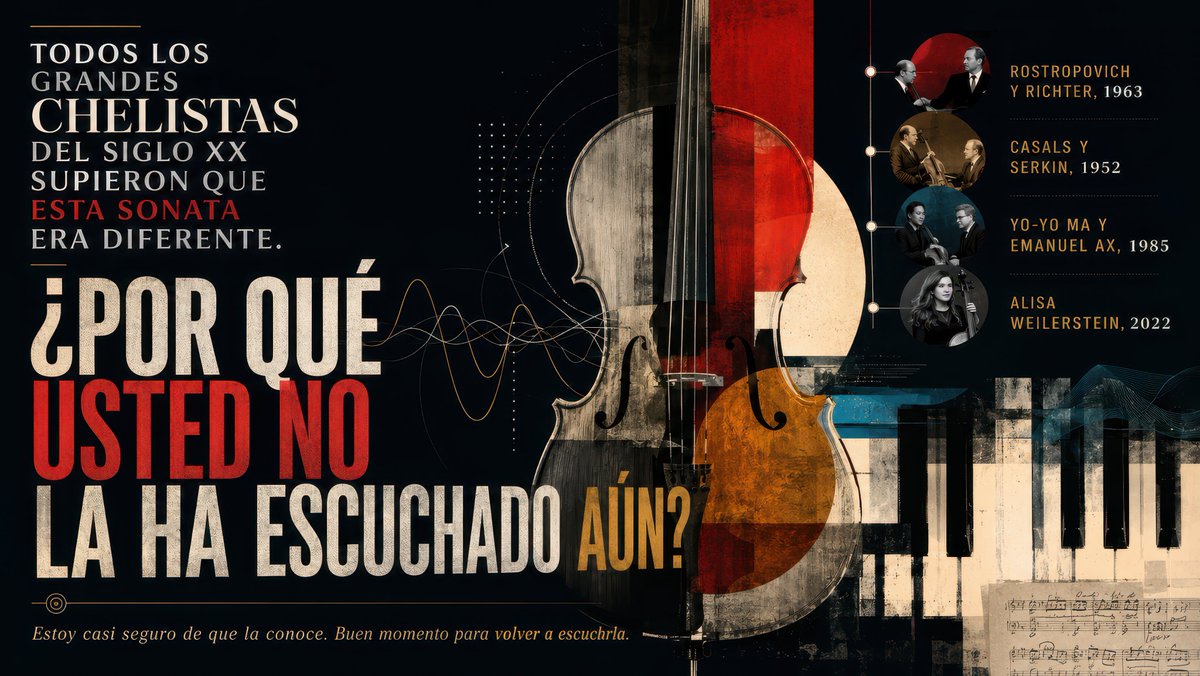
戏剧性大提琴奏鸣曲海报
生成一张电影质感的西班牙古典音乐海报,包含大提琴、钢琴键、醒目的排版以及包含四项传奇录音的时间轴。
Goal: Create a dramatic widescreen editorial poster about a famous cello sonata and its legendary performers, in Spanish, with a classical-music documentary mood.

Canvas: 16:9 horizontal poster, dark charcoal-black background, aged paper texture, high contrast, cinematic lighting, distressed ink and collage grain.

Layout: Left third contains the main Spanish typography in stacked uppercase lines. Center features an oversized vertical cello collage, partly transparent and split into worn cream wood, black, deep red, and amber-orange geometric overlays. Bottom right contains a cropped piano keyboard extending horizontally, with a small fragment of handwritten sheet music beneath it. Right third contains a vertical timeline of recordings with exactly 4 circular musician-photo medallions connected by a thin vertical line and small nodes. Add subtle sound-wave curves, dotted grids, fine technical arcs, and faint music-staff textures around the cello.

Text content: Use this exact main headline on the left, with mixed white, cream, red, and gold emphasis: “TODOS LOS GRANDES CHELISTAS DEL SIGLO XX SUPIERON QUE ESTA SONATA ERA DIFERENTE.” Then very large: “¿POR QUÉ USTED NO LA HA ESCUCHADO AÚN?” Make “USTED NO” bright red, “AÚN?” gold, and the rest distressed cream-white. Bottom left italic sentence: “Estoy casi seguro de que la conoce. Buen momento para volver a escucharla.”

Right-side timeline: Include exactly 4 labeled recording entries, stacked vertically, each aligned to one circular portrait medallion: 1) “ROSTROPOVICH Y RICHTER, 1963”; 2) “CASALS Y SERKIN, 1952”; 3) “YO-YO MA Y EMANUEL AX, 1985”; 4) “ALISA WEILERSTEIN, 2022”. The medallions should look like archival classical-musician photos with muted sepia, black-and-white, and blue-gray tones; the final portrait can be a modern grayscale female cellist image.

Visual style: Sophisticated museum-poster design, bold condensed serif and slab-serif typography, grunge print texture, vintage concert-program aesthetic, elegant gold accents, red circular sun shape behind the top timeline portraits, thin lines and dots like a music-analysis diagram. The cello should dominate the composition and overlap the typography slightly without making the text unreadable.

Customizable parameters: The subject sentence may be {argument name="main claim" default="TODOS LOS GRANDES CHELISTAS DEL SIGLO XX SUPIERON QUE ESTA SONATA ERA DIFERENTE."}; the large question may be {argument name="headline question" default="¿POR QUÉ USTED NO LA HA ESCUCHADO AÚN?"}; the closing line may be {argument name="footer quote" default="Estoy casi seguro de que la conoce. Buen momento para volver a escucharla."}; the instrument focus may be {argument name="central instrument" default="cello"}; the timeline title names may be {argument name="recording list" default="Rostropovich y Richter, 1963; Casals y Serkin, 1952; Yo-Yo Ma y Emanuel Ax, 1985; Alisa Weilerstein, 2022"}.

Constraints: Keep all text legible and spelled exactly as specified, do not add extra recording entries, do not add logos or watermarks, maintain a dark refined classical-music poster atmosphere.
目标:创作一张关于著名大提琴奏鸣曲及其传奇演奏家的戏剧性宽屏编辑海报,使用西班牙语,营造古典音乐纪录片的氛围。
画布:16:9 横向海报,深炭黑色背景,做旧纸张纹理,高对比度,电影级灯光,带有磨损的墨迹和拼贴颗粒感。
布局:左侧三分之一处包含堆叠的大写西班牙语标题。中心设有一个超大的垂直大提琴拼贴画,部分透明,并分割成磨损的奶油色木纹、黑色、深红色和琥珀橙色的几何叠加层。右下角包含一个水平延伸的裁剪钢琴键盘,下方有一小段手写乐谱碎片。右侧三分之一处包含一个垂直录音时间轴,由一条细垂直线和节点连接 4 个圆形音乐家照片勋章。在大提琴周围添加微妙的声波曲线、点阵网格、精细的技术弧线和淡淡的五线谱纹理。
文本内容:左侧使用以下精确的标题,并混合白色、奶油色、红色和金色以作强调:“TODOS LOS GRANDES CHELISTAS DEL SIGLO XX SUPIERON QUE ESTA SONATA ERA DIFERENTE.” 然后是非常大的:“¿POR QUÉ USTED NO LA HA ESCUCHADO AÚN?” 将 “USTED NO” 设置为亮红色,“AÚN?” 设置为金色,其余部分为做旧的奶油白色。左下角斜体句子:“Estoy casi seguro de que la conoce. Buen momento para volver a escucharla.”
右侧时间轴:包含 4 个垂直堆叠的标注录音条目,每个条目对应一个圆形肖像勋章:1) “ROSTROPOVICH Y RICHTER, 1963”;2) “CASALS Y SERKIN, 1952”;3) “YO-YO MA Y EMANUEL AX, 1985”;4) “ALISA WEILERSTEIN, 2022”。勋章应呈现为带有柔和深褐色、黑白和蓝灰色调的古典音乐家档案照片;最后一张肖像可以是现代灰度的大提琴女演奏家图像。
视觉风格:精致的博物馆海报设计,粗体压缩衬线和板状衬线字体,磨损的印刷纹理,复古音乐会节目单美学,优雅的金色点缀,顶部时间轴肖像后方有红色圆形太阳形状,以及类似音乐分析图表的细线条和点。大提琴应占据构图主导地位,并略微覆盖排版,同时确保文字清晰可读。
可自定义参数:主题句可以是 {argument name="main claim" default="TODOS LOS GRANDES CHELISTAS DEL SIGLO XX SUPIERON QUE ESTA SONATA ERA DIFERENTE."};大号问题可以是 {argument name="headline question" default="¿POR QUÉ USTED NO LA HA ESCUCHADO AÚN?"};结束语可以是 {argument name="footer quote" default="Estoy casi seguro de que la conoce. Buen momento para volver a escucharla."};乐器焦点可以是 {argument name="central instrument" default="cello"};时间轴标题名称可以是 {argument name="recording list" default="Rostropovich y Richter, 1963; Casals y Serkin, 1952; Yo-Yo Ma y Emanuel Ax, 1985; Alisa Weilerstein, 2022"}。
约束:保持所有文本清晰且拼写与指定内容完全一致,不要添加额外的录音条目,不要添加徽标或水印,保持深沉、精致的古典音乐海报氛围。